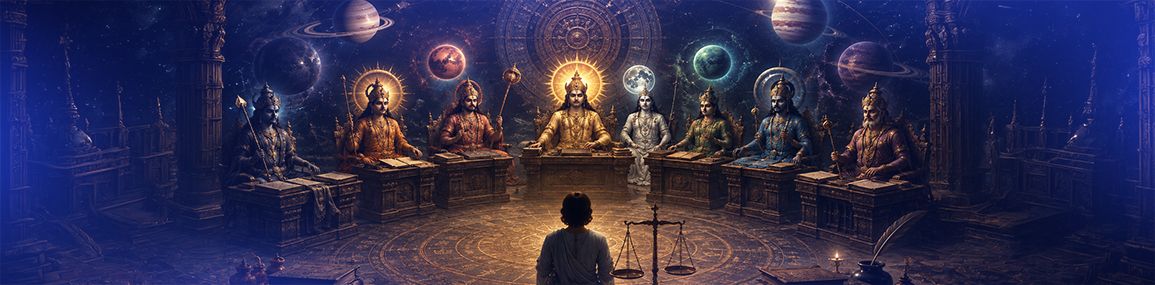
The Karmic Accounts of the Grahas
Explore the karmic accounts of the grahas through the teachings of ancient Jyotisha and understand the deeper connection between karma, Dharma and Vedic astrology.

Dr. Nishchay Nagori
Jyotish Expert
Share this article
A Reflection on the Teachings of Ancient Rishis of Jyotisha
In Vedic astrology, the grahas are not merely celestial bodies associated with different aspects of life. The ancient Rishis of Jyotisha also offered deeper insights into the relationship between the grahas, our actions, and the karma we create through our choices.
The concept of the Karmic Accounts of the Grahas provides a fascinating way to reflect on how our everyday actions may be understood through the principles of Vedic astrology and karma. Each graha is associated with a particular area of karmic observation, reminding us of the responsibilities, choices, desires, and values that shape our lives.
According to ancient rishis, the Mūlatrikoṇa of every graha is like its office, the place from which the graha performs its primary duties.
From this office, the graha is constantly witnessing the karma associated with the 4th house from its Mūlatrikoṇa. This is not a planetary dṛṣṭi (aspect), but rather a subtle observation, a continuous witnessing and recording of our actions.
In a way, each graha maintains its own karmic account, silently accumulating the merits and demerits created through our choices.
If we understand what each graha is constantly witnessing, we can consciously align our actions with Dharma. In doing so, life gradually becomes a blessing. Conversely, if we repeatedly act against these principles, we accumulate karmas that eventually manifest as suffering.
Let us now explore what each graha is witnessing and the karmas it silently records.
Surya: The Karma of Time, Energy and Inner Purification
Surya has its Mūlatrikoṇa in Leo (Siṁha). The 4th house from Leo is Scorpio (Vṛścika). From the perspective of Kālapuruṣa, Scorpio corresponds to the 8th house, the house of Āyu (lifespan), Prāṇa (life force), transformation, and elimination.
Every being is born with a fixed measure of time and life force. Every moment that passes is a portion of that life being spent. Therefore, Surya constantly witnesses a simple but profound question:
Where are you spending your time and energy?
Time is the greatest wealth given to us. Once spent, it can never be reclaimed.
Think of the role of a father in a family. What does a responsible father often observe? He watches where his children invest their time. Are they wasting it, or are they using it to build a meaningful life? Responsibility begins with becoming conscious of time itself.
Whenever we spend our time in activities that promote our material, intellectual, or spiritual growth, we accumulate auspicious Surya karmas. But when our life is consumed by laziness, addictions, distractions, or purposeless pursuits, we begin to accumulate negative Surya karmas.
This is perhaps why great leaders naturally become guardians of time. They understand that success is ultimately nothing more than the wise investment of one's lifespan.
The symbolism extends even deeper.
The 8th house is also associated with the body's process of eliminating waste. Just as the body must regularly release impurities to remain healthy, our consciousness must also release its accumulated impurities.
Surya silently witnesses another question:
Are you collecting more dirt within yourself, or are you cleansing it?
The dirt may take many forms, ego, greed, jealousy, addictions, unhealthy company, destructive habits, or attachment to adharma. Every time we allow these impurities to accumulate, we darken the brilliance of the soul.
On the other hand, whenever we consciously remove these tendencies through self-discipline, noble company, prayer, self-reflection, or righteous living, the inner light begins to shine.
This symbolism also explains the exalted place of the Gāyatrī Mantra, traditionally regarded as one of the highest mantras for inner purification. As the accumulated impurities of karma gradually dissolve, the brilliance of Surya begins to manifest naturally, allowing the individual soul (Jīva) to reflect the radiance of Paramātman.
Ultimately, Surya teaches us that every moment of life is sacred. Use your time wisely. Spend your energy on what elevates yourself and others. Remove inner impurities instead of accumulating them.
When we honour time, purify ourselves, and live responsibly, Surya becomes truly benevolent.
Chandra: The Karma of Nourishment, Love and Learning
Chandra has its Mūlatrikoṇa in Taurus (Vṛṣabha), the 2nd house of the Kālapuruṣa. The 4th house from Taurus is Leo, corresponding to the 5th house, the house of nourishment, love, learning, intelligence, and contentment.
Chandra is constantly witnessing how we nourish life, both physically and emotionally.
Consider the role of a mother. From the very beginning of life, it is the mother who ensures that the child's stomach is full and that the child feels safe, loved, and cared for. She is also the child's very first teacher. Before any formal education begins, it is the mother who teaches the child how to speak, communicate, and understand the world. The very language through which we read, think, and express ourselves is first learned from her.
This beautifully reflects the qualities of Chandra.
The karmas of Chandra are not merely about feeding oneself, but about asking:
Are you nourishing the lives of others?
Do you care for the happiness of your family? Do you bring peace, harmony, and emotional security wherever you go? Do you continue to learn with humility and curiosity, or have you become arrogant, believing there is nothing more to learn?
Whenever we genuinely care for others, support their well-being, and create an atmosphere of love and harmony, we accumulate auspicious Chandra karmas. Likewise, every act of sincere learning, every lesson accepted with humility, and every effort to grow in wisdom strengthens the blessings of Chandra.
On the other hand, Chandra karmas begin to deteriorate when selfishness replaces compassion, when we become indifferent to the needs of others, when our ego prevents us from learning, or when arrogance closes the doors to knowledge. A person who stops learning gradually loses the freshness and innocence that Chandra represents.
Just as the mother nourishes the body with food and the mind with love, we too are called upon to nourish those around us, with kindness, encouragement, understanding, and wisdom.
Ultimately, Chandra reminds us that true fulfillment lies not in receiving love alone, but in becoming a source of nourishment for others. Feed those who are hungry, comfort those who are distressed, continue learning throughout life, and never lose the childlike curiosity that allows the mind to grow.
When we live with compassion, harmony, humility, and a constant desire to learn, Chandra becomes truly benevolent.
Mangal: The Karma of Power, Space and Freedom
Mangal has its Mūlatrikoṇa in Aries (Meṣa). The 4th house from Aries is Cancer (Karka), corresponding to the 4th house of the Kālapuruṣa, the house of land, home, happiness, emotional security, and the space in which life unfolds.
Mangal is Bhūmi putra, the son of Mother Earth. The very ground upon which we stand, the land we inhabit, and the space we call our own are all under his domain. Just as Surya grants us Time, Mangal grants us Space, the sacred space in which we live, grow, and fulfill our destiny.
Mangal is constantly witnessing a profound question:
How do you use the space and power that have been entrusted to you?
The 4th house is not merely the house of land. It is also the house of peace, happiness, and one of the Mokṣa Kendras. Every individual deserves a space where they can live with dignity, security, and freedom.
Whenever we violate another person's space, physically, emotionally, or socially, we begin to accumulate adverse Mangal karmas.
This may happen when we constantly interfere in the lives of others, disturb their peace, invade their personal boundaries, or exploit our strength to intimidate those who are weaker. It also manifests when land is seized unjustly, when freedom is taken away by force, or when power is exercised for selfish gain rather than for justice.
Power without Dharma inevitably becomes oppression.
Mangal reminds us that strength is not given so that we may dominate others, but so that we may protect them.
A true warrior does not fight to satisfy pride or display superiority. A true warrior fights to preserve righteousness, defend the helpless, and protect the freedom and happiness of others. Courage reaches its highest expression when it is guided by compassion and responsibility.
Remember, Surya has given you Time, and Mangal has given you Space. These are two of life's greatest gifts. Use both wisely, for your own growth and for the welfare of those around you.
The highest teaching of Mangal may be expressed in a simple principle:
Live and Let Live.
Stand firmly against injustice but never become the source of injustice yourself. Fight for the rights of those who cannot defend themselves. Protect rather than exploit. Build rather than destroy. Use your strength to uplift rather than suppress.
As the saying goes, "With great power comes great responsibility." Mangal embodies this truth. Whenever power is misused, karmic debts are created. According to the law of karma, those who exploit others today may one day experience what it means to live without freedom themselves.
When strength is guided by Dharma, courage becomes service, power becomes protection, and Mangal becomes truly benevolent.
Budha and Rahu: The Karma of Ethics in Growth
Budha has its Mūlatrikoṇa in Virgo (Kanyā). The 4th house from Virgo is Sagittarius (Dhanu), corresponding to the 9th house of the Kālapuruṣa, the house of Dharma, Guru, father, higher wisdom, ethics, and righteous conduct.
According to this teaching, Budha is constantly witnessing the 9th house, asking a fundamental question:
Is your growth rooted in Dharma?
Budha governs learning, intelligence, analysis, communication, commerce, and execution. It is the graha that enables us to develop our skills, compete in the world, solve problems, and transform knowledge into action.
Growth is natural. Success is desirable. Competition is inevitable.
But Budha silently observes how growth is achieved.
Every action we perform, every decision we make, and every success we attain should be supported by Dharma. Intelligence without ethics eventually becomes manipulation. Skill without integrity becomes exploitation. Knowledge without wisdom loses its true purpose.
Whenever we pursue our goals honestly, respecting the principles of Dharma, we accumulate auspicious Budha karmas. Every achievement earned through sincerity, discipline, and ethical conduct strengthens the blessings of Budha.
However, Budha karmas begin to deteriorate when growth is pursued through dishonest means. Cheating, deception, manipulation, corruption, plagiarism, exploiting loopholes, or advancing by harming others may produce temporary success, but they create lasting karmic debts.
True growth should never be built upon the suffering or downfall of another.
The real measure of intelligence is not merely the ability to succeed, but the ability to succeed without compromising one's principles.
The same teaching beautifully extends to Rahu, for Rahu also has its Mūlatrikoṇa in Virgo. Therefore, Rahu is witnessing the very same field of karma.
Rahu often tempts us with shortcuts. It promises quick success, effortless gains, recognition without merit, and power without discipline. It encourages us to believe that the destination matters more than the path.
Yet the law of karma never overlooks the path.
Whenever we mislead others, manipulate the truth, deceive for personal gain, or seek success through unethical means, Rahu records those actions. The very deception we inflict upon others eventually returns to us in one form or another. One who cheats eventually experiences what it means to be cheated.
Rahu teaches that there are no true shortcuts in the journey of Dharma. Every shortcut eventually becomes a detour, while every honest effort becomes a lasting foundation.
Therefore, the highest teaching of Budha and Rahu is remarkably simple:
Let your intelligence be guided by Dharma.
Learn continuously. Grow fearlessly. Compete sincerely. Execute your responsibilities with excellence but never sacrifice ethics for achievement.
When success is earned through righteousness rather than deception, both Budha and Rahu become benevolent, and growth becomes lasting merit rather than temporary gain.
Guru: The Karma of Giving, Spending and Surrender
Guru has its Mūlatrikoṇa in Sagittarius (Dhanu). The 4th house from Sagittarius is Pisces (Mīna), corresponding to the 12th house of the Kālapuruṣa, the house of expenditure, charity, liberation (Mokṣa), sleep, foreign lands, renunciation, and the dissolution of the ego.
According to this teaching, Guru is constantly witnessing the 12th house, silently asking:
Where are you spending the resources that have been entrusted to you?
Expenditure is not limited to money alone. Every day we spend our wealth, our time, our energy, our knowledge, and our attention. Every expenditure becomes a karmic investment, and Guru observes whether that investment leads us closer to Dharma or further away from it.
When we spend our resources for the welfare of ourselves and others, Guru's account fills with merit. Every act of generosity, every contribution to a noble cause, every sincere investment in education, health, spiritual growth, or the upliftment of society becomes an offering that nourishes the soul.
However, the same resources can also become the cause of bondage.
When wealth is wasted on addictions, indulgence without purpose, gambling, exploitation, or pursuits that harm ourselves or others, adverse Guru karmas begin to accumulate. Resources that could have supported growth are instead consumed by desires that leave the heart emptier than before.
The 12th house also governs sleep. A peaceful sleep is often the reflection of a peaceful conscience. When our expenditures are driven by greed, attachment, or unethical pursuits, the mind becomes restless, and even in abundance, true peace remains elusive.
Guru reminds us that prosperity is measured not merely by how much we possess, but by how wisely we use what we have been given.
Another profound teaching of the 12th house is letting go.
Human beings naturally seek to accumulate, wealth, possessions, achievements, recognition, relationships, and identities. Yet the path of Guru gently reminds us that nothing in this world is truly ours forever. Everything that comes into our hands is entrusted to us for a time, and one day, everything must be returned.
Therefore, Guru encourages the practice of Aparigraha, non possessiveness.
Share what you can. Donate according to your capacity. Support noble causes. Give without expectation of recognition. Let your wealth become a source of compassion rather than attachment.
This principle extends beyond material possessions. We are also invited to surrender our pride, our ego, and the illusion of ownership. The highest expenditure is the expenditure of the ego itself.
One who constantly offers every action, every success, and every possession to the Divine gradually becomes free from bondage.
Guru also reminds us to cultivate reverence for all living beings. To unnecessarily harm or destroy life for selfish purposes creates karmic burdens, while compassion, kindness, and the protection of life generate lasting merit.
Ultimately, Guru teaches that true wealth is not found in accumulation, but in right expenditure.
Spend wisely. Give generously. Live compassionately. Let go gracefully. Surrender completely.
When our resources become instruments of Dharma rather than instruments of desire, Guru becomes truly benevolent, and every act of giving becomes a step toward liberation.
Shukra: The Karma of Responsibility, Relationships and Worldly Fulfillment
Shukra has its Mūlatrikoṇa in Libra (Tulā). The 4th house from Libra is Capricorn (Makara), corresponding to the 10th house of the Kālapuruṣa, the house of karma, responsibility, work, achievement, and one's contribution to society.
According to this teaching, Shukra is constantly witnessing the 10th house, silently asking:
Are you fulfilling your responsibilities in the practical world?
Shukra is often associated with beauty, love, relationships, comfort, and enjoyment of life. Yet these blessings can only be sustained through responsibility. Happiness is not merely received. It must also be created and protected through sincere effort.
The 10th house reminds us that every relationship carries responsibility. Love is not sustained by emotions alone. It is strengthened through commitment, action, and service.
This becomes especially evident after marriage.
A life partner often becomes a mirror, reminding us that life is no longer lived only for oneself. One must now work to create security, stability, comfort, and prosperity for another soul as well. The practical responsibilities of life naturally increase, and Shukra quietly observes how we respond to them.
Do we work sincerely to ensure the well being of our family?
Do we use our skills and knowledge to build a life of dignity and fulfillment?
Do we honour the trust placed in us by those who depend upon us?
Whenever we accept these responsibilities with sincerity, we accumulate auspicious Shukra karmas. Every honest effort to provide, protect, support, and bring happiness to our loved ones becomes an offering that strengthens the blessings of Shukra.
However, Shukra karmas begin to deteriorate when pleasure becomes more important than responsibility.
When we seek only enjoyment while neglecting our duties, when we pursue indulgence without discipline, or when we ignore the practical needs of those who rely upon us, we gradually create karmic debts. A relationship cannot flourish where responsibility is absent.
Bhoga has its rightful place in life, but it should never come at the expense of Dharma.
Shukra teaches that true enjoyment is the natural fruit of a life lived responsibly. Pleasure without responsibility eventually becomes emptiness, whereas responsibility embraced with love becomes lasting fulfillment.
Therefore, fulfil your duties before seeking comfort. Let your actions reflect your love. Build a life where your knowledge, skills, and efforts become a source of happiness for your family and for society.
When responsibility precedes enjoyment, relationships become sacred, prosperity becomes meaningful, and Shukra becomes truly benevolent.
Shani: The Karma of Wealth, Speech and Integrity
Shani has its Mūlatrikoṇa in Aquarius (Kumbha). The 4th house from Aquarius is Taurus (Vṛṣabha), corresponding to the 2nd house of the Kālapuruṣa, the house of wealth, speech, food, family values, and accumulated resources.
According to this teaching, Shani is constantly witnessing the 2nd house, silently asking:
How do you earn, speak, and consume?
The 2nd house is not merely the house of wealth. It is the house of how wealth is accumulated. It governs the source of our income, the words that leave our mouth, and the food that enters it.
Shani, the great lord of Karma, carefully observes whether what we accumulate has been earned through righteousness or through the suffering of others.
Money, by itself, is neither pure nor impure. It is the means by which it is earned that determines its karmic quality.
Whenever wealth is acquired through honesty, hard work, service, and ethical conduct, we accumulate auspicious Shani karmas. Such wealth carries peace, dignity, and stability because it has not been built upon another person's pain.
However, adverse Shani karmas arise when wealth is obtained through corruption, exploitation, deceit, theft, oppression, or by taking what rightfully belongs to another. Wealth gained through another's suffering may bring temporary comfort, but it carries an unseen karmic burden.
Shani therefore reminds us:
Never allow your prosperity to become the reason for another person's misery.
The 2nd house also governs speech.
Every word we speak leaves an impression upon the world. Harsh speech, lies, gossip, insults, and words spoken with the intention to wound others gradually create adverse Shani karmas.
On the other hand, truthful, compassionate, and thoughtful speech becomes a source of merit.
Shani silently witnesses not only how much we speak, but why we speak.
The same principle extends to food, another significator of the 2nd house.
The tongue performs two actions. It tastes and it speaks. Both require discipline.
When we become slaves to taste, constantly seeking only sensory pleasure while neglecting what truly nourishes the body, we weaken ourselves. Likewise, when we allow the tongue to speak without restraint, we often wound others before we realise it.
The discipline of the tongue, both in what enters it and what leaves it, is one of Shani's greatest lessons.
There is also a beautiful relationship between Guru and Shani.
Guru witnesses the 12th house, asking:
How do you spend what you have?
Shani witnesses the 2nd house, asking:
How did you earn what you have?
Together, they complete the cycle of Dharma.
Guru teaches the right expenditure.
Shani teaches righteous accumulation.
When wealth is earned honestly and spent wisely, prosperity itself becomes an instrument of Dharma.
Ultimately, Shani reminds us that true wealth is not measured by the size of one's possessions, but by the purity of one's earnings, the truthfulness of one's speech, and the discipline of one's senses.
Earn only what you rightfully deserve. Let your words heal rather than harm. Eat what nourishes the body rather than merely satisfying the tongue.
When integrity becomes the foundation of your livelihood, your speech reflects truth, and your actions remain free from exploitation, Shani becomes truly benevolent.
Ketu: The Karma of Desire, Detachment and Liberation
Ketu has its Mūlatrikoṇa in Pisces (Mīna). The 4th house from Pisces is Gemini (Mithuna), corresponding to the 3rd house of the Kālapuruṣa, the house of desire, initiative, effort, communication, and the impulses that drive our actions.
According to this teaching, Ketu is constantly witnessing the 3rd house, silently asking:
Do your desires liberate you, or do they bind you?
The 3rd house is where countless desires arise. It is the place of ambition, curiosity, courage, and also of the endless stream of wants that emerge within the human mind.
Every desire has the potential either to inspire growth or to strengthen our attachment to the world.
Ketu quietly observes how we respond to these desires.
When desires are governed by wisdom and restraint, they become instruments for growth. But when they are allowed to multiply without discrimination, they gradually bind us more deeply to Māyā. The more we chase every passing impulse, the stronger the patterns of attachment become.
This is why Ketu values Ankuśa, self-restraint.
Without restraint, even the strongest mind becomes a servant of its own cravings. Whether the desire is for pleasure, recognition, possessions, or power, an uncontrolled mind is never truly at peace.
According to this teaching, adverse Ketu karmas begin to accumulate when we spend our lives endlessly creating new desires, new attachments, and new identities, forgetting that everything in this world is temporary.
The 3rd house is also the exaltation sign of Rahu. Rahu encourages expansion, acquisition, and experience, while Ketu gently reminds us that no worldly achievement can offer lasting fulfillment unless it is accompanied by inner freedom.
Therefore, Ketu teaches the practice of Aparigraha, non-possessiveness.
Consciously let go of what no longer serves your growth. Release unnecessary attachments, unhealthy patterns, and the habits that repeatedly bind the mind. Every act of surrender lightens the burden of karma and brings us one step closer to inner freedom.
Ketu also encourages the cultivation of gratitude.
Rather than constantly longing for what is absent, pause to recognise the abundance that already exists in your life. Gratitude transforms desire into contentment, and contentment becomes the doorway to peace.
Ultimately, Ketu reminds us of a profound truth:
Everything we possess today will one day be left behind.
Knowing this, learn to hold the world gently rather than tightly. Live fully, perform your duties sincerely, but remain inwardly free. Let every attachment gradually become an offering to the Divine.
When desires are governed by wisdom, attachments are replaced with surrender, and gratitude becomes our natural state, Ketu becomes truly benevolent. In that surrender, the soul begins its journey toward liberation.
The Karmic Questions of the Grahas
The teachings of Jyotisha invite us to look beyond prediction and towards self-reflection. The grahas can be understood as reminders of the principles that govern our actions and responsibilities.
Surya: How do you spend your time?
Chandra: How do you nurture your life and the life around you?
Mangal: How do you use your power and respect space and boundaries?
Budha and Rahu: Is your growth rooted in Dharma?
Guru: Where do you spend your resources?
Shukra: Do you fulfil your responsibilities before seeking enjoyment?
Shani: How do you earn, speak, and consume?
Ketu: Do your desires liberate you, or do they bind you?
These questions offer a simple yet profound way to reflect upon karma and astrology. They remind us that the wisdom of Vedic astrology is not only about understanding planetary influences, but also about becoming more conscious of our own choices.
When we align our actions with Dharma, our relationship with the grahas also becomes a journey of awareness, responsibility, and inner growth.
For those who wish to explore their birth chart and understand the deeper influence of the grahas in their life, a personalised Vedic astrology consultation can offer greater insight into planetary influences, life patterns, and important areas of focus.
You can consult Dr. Nishchay Nagori Ji to explore your birth chart through the wisdom of Jyotisha and gain a deeper understanding of the planetary influences shaping your life.
Book a consultation with Dr. Nishchay Nagori Ji and explore your birth chart with greater clarity and awareness.